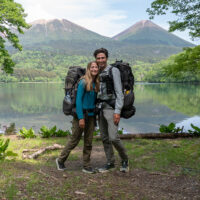
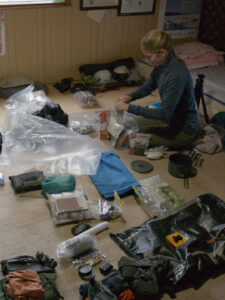
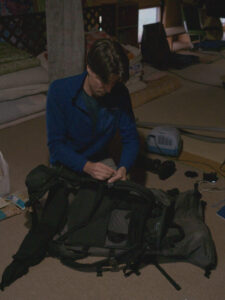
From Sapporo, we took a bus to Kushiro and then another bus onward to Rausu, a small but bustling fishing town on the edge of the Shiretoko Peninsula. We stayed in a Rider House, sleeping in the attic. A kind elderly man welcomed us, and we both did our best to understand each other. It quickly became clear that our translation app was not nearly as effective as we had hoped. Japanese and English are built so differently that a lot gets lost in translation. The attic was old, dark and entirely made of wood. It looked self-built, with screws sticking out of the wooden panels. Long bathrobes, Japanese robes and winter jackets hung from the beams, while piles of bedding, mattresses and old furniture filled the corners. Messages from travelers who had stayed there years before covered parts of the walls. It felt messy but cozy, with plenty of snug corners for travelers to sleep. We settled into a dark little corner on a wool blanket and had the whole attic to ourselves, apart from a few crickets hopping around. It was the perfect place to organize our gear before beginning the Shiretoko Cape hike.
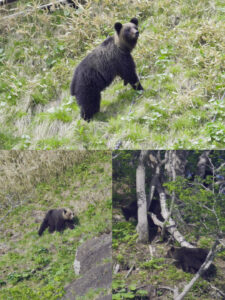
Our adventure finally began. Fully packed and ready to go, we hiked from the Rider House toward Aidomari, literally “the end of the road.” Not long after setting out, Roel spotted our first brown bear on a hillside beside the road. A very large Ezo bear was staring straight at us. I immediately felt the tension rush through my body. The bear lifted its nose toward us and took several deep sniffs. After which he decided he wasn’t hungry for smelly hikers and climbed back up the hill. We had seen our first bear! Excited, we continued walking and eventually arrived in Aidomari.
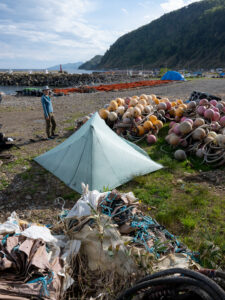
We asked around about camping and were offered a spot next to a collapsed wooden building with a rusty car next to it and endless piles of buoys and fishing nets. The air smelled strongly of chemicals, probably epoxy used for repairing fishing boats in the harbor. It was completely the opposite of the wilderness campsite we had imagined, but we liked it nonetheless. Our first night camping in bear country was nerve-racking. At one point, we heard rustling in the bamboo behind our tent. We lay awake, eyes wide open, listening carefully. This tent certainly wasn’t going to protect us from a bear. After a while, we recognized the sound of the footsteps: slow, careful, and light. Most likely a deer. Still, sleep was hard to come by that night.
The next morning, we woke up before 4 a.m. to take advantage of the low tide necessary to pass several sections of the coastline. We were excited, and I have to admit I was also a little scared. I knew this would be a demanding hike and Shiretoko is famous for having the highest densities of brown bears in Japan.
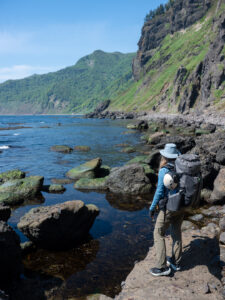
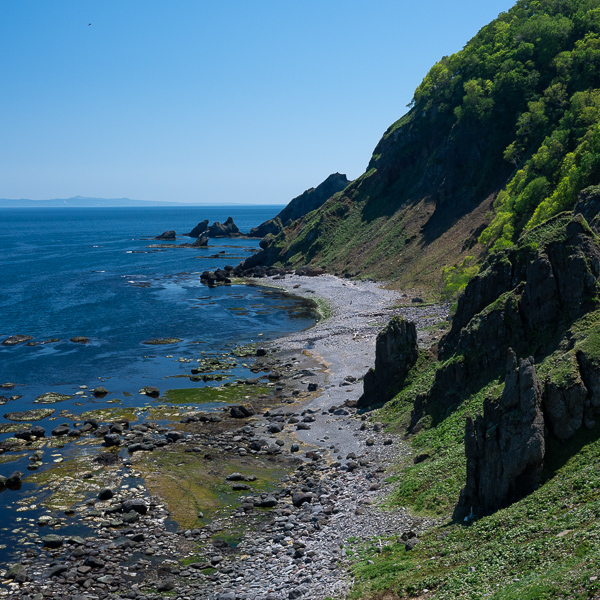
Walking along the beach sounds easy, but these weren’t smooth sandy beaches. Rounded stones constantly rolled beneath our feet. Every step had to be carefully placed, challenging the small muscles and tendons in our ankles and feet. The views however were spectacular. Every bay revealed rugged cliffs and and the lush green vegetation that’s bursting back to life after winter. Across the water, we could even see the outline of Russia’s Kamchatka Peninsula. The weather was perfect. Sunshine, little wind and a full moon that created the lowest tides we could hope for.
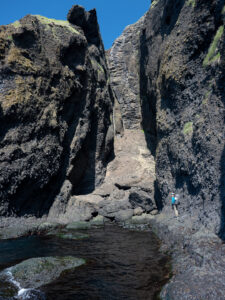
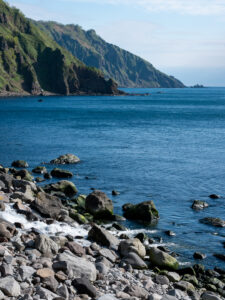
Soon the route became more demanding. Countless rock formations had to be climbed over, squeezed through and navigated around. Then came the first rope climb. The slope was incredibly steep, perhaps close to 80 degrees and the rope was essential for pulling ourselves upward. Even while climbing up I was already worrying about having to descend it later. Between the difficult sections we sat in the sun, enjoying its warmth on our skin while gazing out over the deep blue ocean and the dramatic shapes of the peninsula.
Throughout the hike we constantly scanned the hillsides and clapped our hands before rounding corners. Trying to make sure we didn’t accidentally surprise a bear. One unforgettable moment was discovering a fox den. A mother fox nursing her three tiny cubs and afterwards resting on the rocks. The nine-hour hiking day was both beautiful and exhausting. Eventually, we reached an old abandoned harbor where we spent the night. Thankfully the bears left us alone once again.
The following day brought even steeper climbs. Eventually I reached a point where I wasn’t sure I could continue. The constant concentration required for navigating difficult terrain, climbing over rocks and hanging onto ropes had completely drained both my muscles and my mind. We decided that Nenbetsu Rock would be our northernmost point before turning around and heading back.
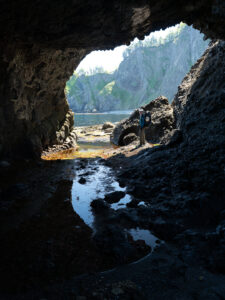
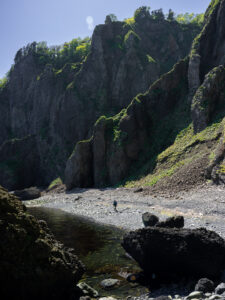
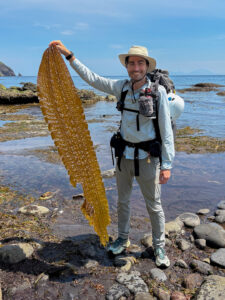
Along the way back we explored the tide pools searching for marine life. We found all sorts of fascinating creatures including sea angels, sea grapes, a small eel, and of course plenty of the famous kombu seaweed for which the region is known. We hadn’t calculated the tides for the return journey that day, but luckily it all worked out fine. At one point we had to hike through the sea because the higher path we had taken on the way out was crumbling away beneath our feet. Not wanting to slide down the slope the calm ocean looked like the better option that day. We made it to one of the beaches where there was a house. It looked like an old, or maybe still used, fishing place. We put up our tent there for the night.
The next morning, Roel suddenly yelled excitedly. There was a brown, furry spot on the mountain. Slowly it descended, sometimes disappearing behind bushes and trees before coming into view again. As we kept watching, we realized it wasn’t just one bear but two. Later when we looked at the video footage we even spotted a third bear hiding behind a tree.
We continued hiking and reached the two steep abseil cliffs. For me it was a challenge. My body was shaking and Roel even climbed each cliff twice to carry my backpack. I was so relieved when we made it down and could finally start to relax a little.
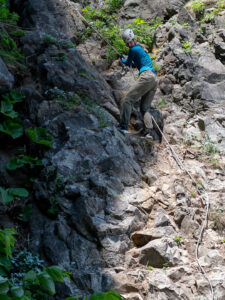
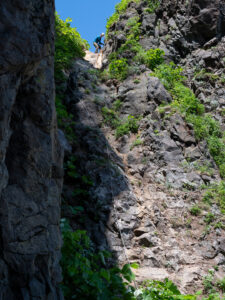
Just before the end of the route, only a few meters away from us, there was suddenly a huge rustling in the bamboo and a bear ran off. We were both startled and excited and immediately started talking about how close it had been.
Back in Aidomari we made the ambitious decision to continue all the way back to the Rider House. It probably wasn’t our best idea. Completely exhausted, covered in blisters, and stumbling on tired legs, we finally arrived.
Since Rausu is famous for its seafood and kombu, we didn’t want to leave without trying the local specialties. Roel picked what looked like the perfect restaurant. Both for its atmosphere and its menu. We painfully walked there on our blistered feet, looking forward to fresh salmon and sea urchin, only to discover it happened to be closed that day. Disappointed but still hungry, we chose another restaurant instead. Fortunately, it turned out to be excellent. We enjoyed delicious salmon and a bowl of Rausu kombu ramen. A perfect ending to an unforgettable adventure in Shiretoko, one of Japan’s wildest places.